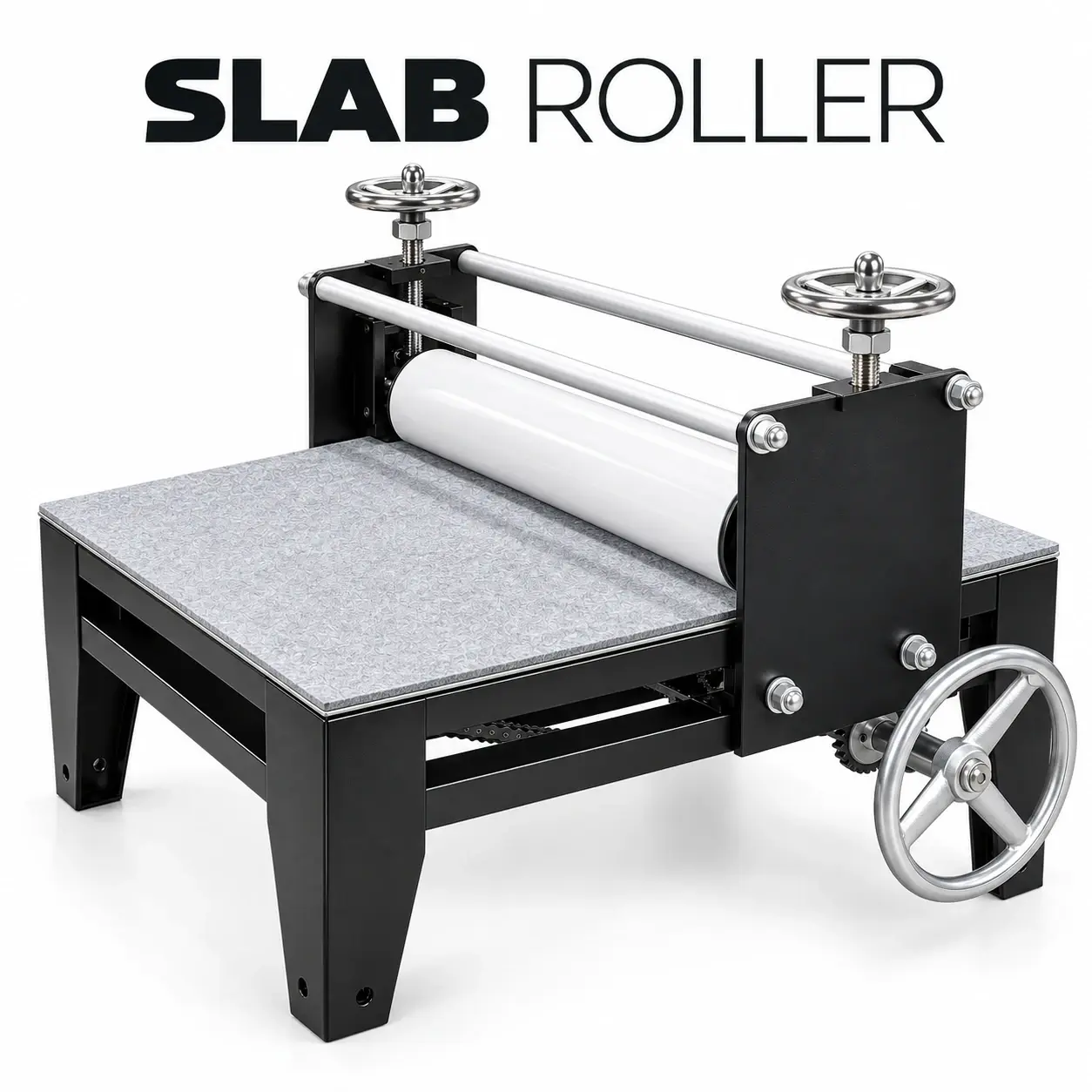
Manual slab roller creates consistent clay sheets for hand-building and studio work.
Preorder
Pottery Slab Roller 89mm Steel Shaft for Tabletop Clay Work
SKU: PPK00022
$1,379.99
- Slab thickness
- 0–6 cm
- Dimensions
- Approx. 50cm H × 45cm W × 70cm L
- Roller shaft
- 89mm stainless steel
Built for the job.
A robust manual slab roller for producing consistent clay slabs in pottery and ceramics studios. Its compact tabletop footprint combines a thick-wall seamless steel frame with an 89mm stainless-steel roller shaft for controlled, repeatable rolling.
Thick-wall seamless steel construction provides a stable rolling platform.
89mm stainless-steel roller shaft supports smooth, controlled passes.
Compact tabletop format measures approximately 50cm high, 45cm wide and 70cm long.
Remove the supplied felt during use and provide a suitable linen or canvas rolling cloth.
Technical specifications
Final accessories, availability and shipping are confirmed before dispatch.
Product typeManual pottery slab roller
Slab thickness0–6 cm
DimensionsApprox. 50cm H × 45cm W × 70cm L
Roller shaft89mm stainless steel
FrameThick-wall seamless steel
WeightApprox. 30kg
Rolling clothSuitable linen or canvas required
ShippingCalculated from delivery address at checkout
What's included
- Pottery slab roller
- Protective felt
Warranty & support
12-month warranty support pathway on eligible products. Freight, misuse, consumables, installation errors and normal wear are excluded unless required by New Zealand law.
FAQ
What workbench does the slab roller need?
Allow for the approximately 70 × 45cm footprint and 30kg machine weight, plus clear feed and exit space on both sides. Use a rigid, level bench that does not rock or flex, and use two-person lifting or suitable handling equipment when placing the roller.
Do I roll clay directly on the supplied felt?
No. Remove the felt before rolling and provide a clean, suitable linen or canvas cloth above and below the clay. The cloth helps the slab feed consistently and release from the rollers; wrinkles or trapped dry clay will mark the finished surface.
How do I keep the slab thickness even?
Set the adjustment on both sides to the same height before each pass, centre the clay and keep the cloth square to the rollers. Reduce thick clay through several smaller passes instead of forcing it to the final thickness in one pass; excessive resistance means the feed clay is too thick or uneven.
What clay preparation gives the best result?
Use soft, well-wedged clay with an even starting shape. Pre-flatten very thick blocks, keep the clay within the usable roller width and avoid hard inclusions that could damage the cloth or mark the 89mm stainless-steel roller shaft.
How should I clean and maintain it?
Remove clay from the cloth after each session and let the cloth dry flat. Wipe the roller and table with a damp cloth, then dry the steel surfaces; do not spray water into bearings or adjustment hardware. Check that both sides move freely and remain level before the next use.